Customer.io Alternatives for Lifecycle Email (2026)
Loops is the alternative to price first if you run a SaaS product, your Customer.io bill is the complaint, and your messages are driven by a handful of events: on 7 Oct 2026 its slider read $99 a month at 9,998 subscribed contacts and $249 at 49,989, against Customer.io Essentials at $145 for 10,000 profiles and $505 or more at 50,000. Userlist is the pick when the company, not the person, is your unit. Below: why teams leave, costs at 5,000 to 50,000 contacts, and what a migration has to rebuild.
By Owen Hargrove · Updated 7 Oct 2026
TL;DR: where to go from Customer.io
- Small SaaS team, a few core journeys? Loops: free to 1,000 contacts, then $99 a month at about 10,000.
- B2B product where accounts matter? Userlist: Basic is $149 a month for up to 10,000 users, with company-level segments.
- Few events, lots of newsletters? Brevo charges by send volume, free at 300 a day.
- Marketers want to own the canvas? ActiveCampaign, but it costs more than Customer.io at 20,000 contacts.
- Early-stage and under $10M raised? Stay: Customer.io's Startup Program offers 12 months free.
List your events, objects, Liquid templates and suppression lists first. They determine how hard the move is.
Why teams leave Customer.io
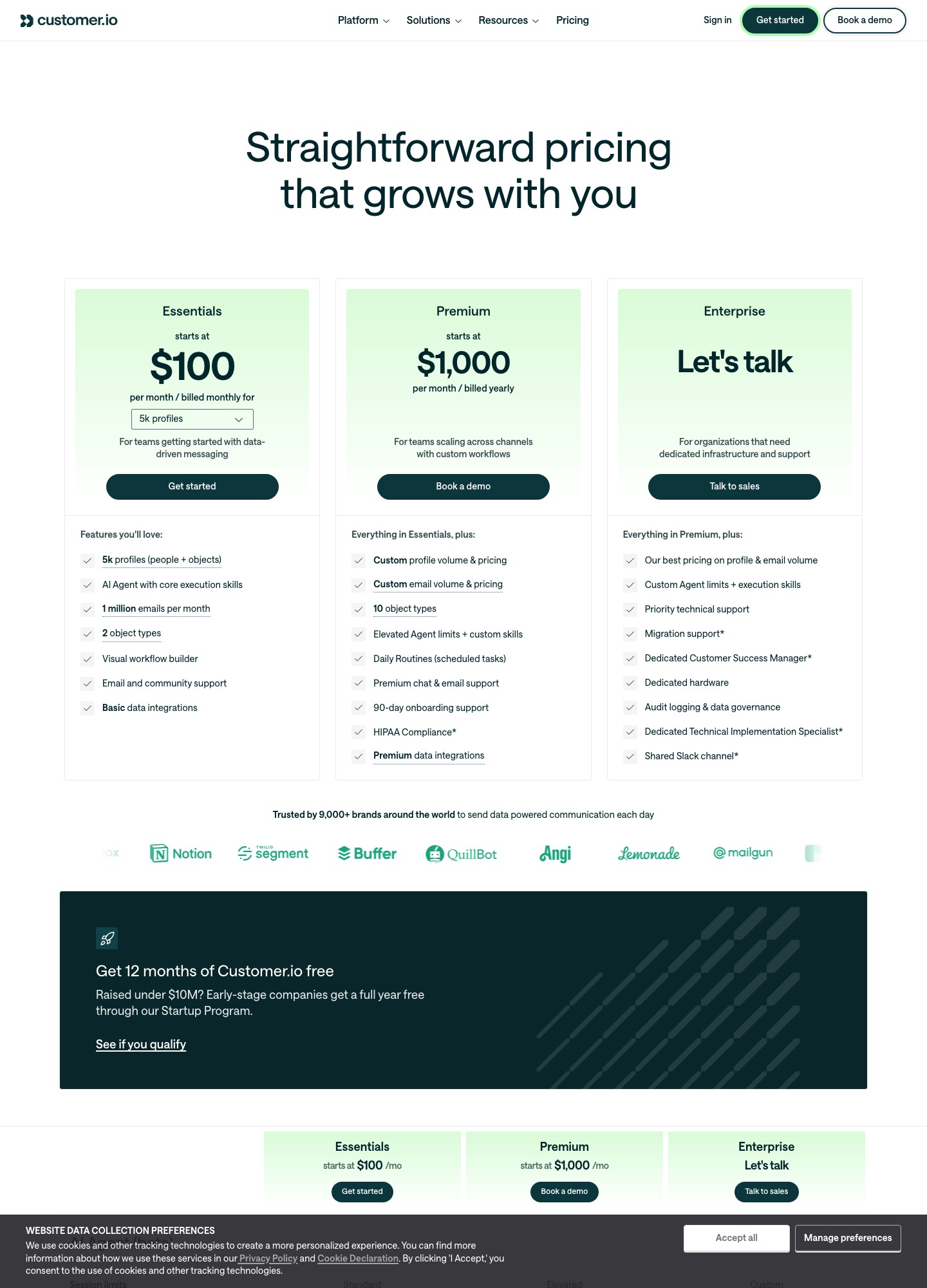
Customer.io's pricing page sells Essentials from $100 a month billed monthly for 5,000 profiles (people and objects), with one million emails a month included. The selector steps up by $90 for each extra 10,000 profiles: $145 at 10,000, $235 at 20,000, $325 at 30,000, $415 at 40,000 and $505 or more at 50,000. Extra profiles cost $0.009 each and extra emails $0.12 per 1,000.
The billing rule is the second complaint. Its documentation says a profile counts for the month if it existed at any point in it, even if you delete it, so cleaning a list mid-month does not lower that month's bill. Loops, by contrast, says unsubscribed contacts do not count.
The third is scope. Essentials lists email and community support, two object types, basic data integrations and no managed deliverability; HIPAA compliance, custom volume pricing and ten object types sit on Premium, which starts at $1,000 a month billed yearly. And since Customer.io is built to react to events you send, someone on your team must define, name and maintain them. Teams without that person tend to feel the platform as weight, not power.
Shortlist: all 9 alternatives
| # | Alternative | Best for | Price signal from its own page | What you give up |
|---|---|---|---|---|
| 1 | Loops | Lean SaaS event email | Free to 1,000 contacts; $99 at 9,998 | Branching and object depth |
| 2 | Userlist | Account-based B2B SaaS | Basic $149, Professional $349 at 10,000 users | General marketing breadth |
| 3 | Brevo | Newsletters and a few flows | Free; Starter $9; Standard $18 | Event-driven design |
| 4 | ActiveCampaign | Marketer-owned automation | Starter $149 at 10,000 contacts | A lower bill past 10,000 |
| 5 | HubSpot | Sales-led teams | Free tools; Starter $7; Professional $800 | Cheap behavioral triggers |
| 6 | MailerLite | Newsletter-first teams | Comfort $89, Power $129 at 10,000 | App-event triggering |
| 7 | Intercom | Support-adjacent messaging | Advanced $85 per seat a month | Email breadth |
| 8 | Braze | Cross-channel at scale | Pricing on request (quote-based) | Small-team simplicity |
| 9 | Kit | Creator-led products | Creator $116 at 10,000 | Product-event logic |
What the same audience costs at 5,000 to 50,000
Monthly figures from each vendor's selector on 7 Oct 2026. Customer.io's are billed monthly; ActiveCampaign's are annual-billing rates; Loops and Userlist count different things (subscribed contacts and tracked users), so use the rows as a guide.
| Plan | 5,000 | 10,000 | 20,000 | 50,000 |
|---|---|---|---|---|
| Customer.io Essentials | $100 | $145 | $235 | $505 or more |
| Loops (subscribed contacts) | $48 at 4,788 | $99 at 9,998 | $198 at 24,339 | $249 at 49,989 |
| Userlist Basic (users) | $149 (plan covers 10,000) | $149 | $249 | not read |
| ActiveCampaign Starter | $79 | $149 | $311 | not offered above 25,000; Plus $609 |
| ActiveCampaign Plus | $145 | $189 | $329 | $609 |
| MailerLite Comfort | $49 | $89 | not read | not read |
The arithmetic: at about 10,000 contacts Loops is $46 a month under Customer.io ($145 minus $99), which is $552 a year. At about 50,000 it is $256 a month under ($505 minus $249), so at least $3,072 a year. Userlist's twenty-thousand figure follows its own formula of $149 for the first 10,000 users plus $10 per extra 1,000, giving $249, which is $14 above Customer.io's $235. Its page shows $229 at 18,000 users and $369 at 32,000, in line with that formula. ActiveCampaign Starter at 20,000 contacts is $311, $76 above Customer.io, so that move trades flexibility for a higher bill.
Brevo, Intercom and Braze use other meters. Brevo prices by monthly email volume, Intercom charges per seat (Advanced $85, Expert $132 a month) plus usage such as $0.99 per Fin outcome, and Braze states that it bills by the volume of users engaging with your brand.
1. Loops : best for a lean SaaS team with a few core journeys
Why switch: Loops' pricing page says paid plans are priced by subscribed contacts, with unlimited sends, transactional email included and no team-seat fees. The free plan covers up to 4,000 sends in a rolling 30 days to your 1,000 newest contacts, with all features available and a small footer.
What you give up: Customer.io's data model. Objects, deep branching and a large integration list are the reasons its Essentials card costs more. Loops fits when your lifecycle is sign-up, activation, a nudge, and an upgrade message.
Rebuild first: the onboarding series triggered by your sign-up event. See also our Loops alternatives page for the opposite direction.
2. Userlist : best for B2B products where the company is the unit
Why switch: Userlist's pricing page lists Basic at $149 a month and Professional at $349 for up to 10,000 users, with extra users at $10 and $12 per 1,000. Both include segments for users and companies; Professional adds A/B split testing, conversion goals and advanced workflow features. The message allowance is five times tracked users, with a 500,000 floor and $1 per extra 1,000 messages.
What you give up: savings. $149 is $4 above Customer.io at 10,000, and the gap widens with size: $249 against $235 at 20,000, and $369 at 32,000 users against $325 at 30,000 profiles.
Rebuild first: a team-trial journey that checks how many colleagues have joined the company.
3. Brevo : best when newsletters outnumber event-driven flows
Why switch: Brevo's plan article describes a free plan with 300 daily sends, transactional email and SMS, and automation for up to 2,000 contacts. Starter begins at $9 and Standard at $18 a month, with Standard running automation across unlimited contacts.
What you give up: event-first design. Brevo's strength is campaigns and multi-channel sending; confirm how your product events would reach it before you move.
Rebuild first: one transactional template and one campaign, to measure deliverability on a clean sender setup.
4. ActiveCampaign : best when marketers, not engineers, should own the workflows
Why switch: ActiveCampaign's selector reads Starter at $79 a month for 5,000 contacts, $149 at 10,000, $311 at 20,000, and Plus at $189 and $329 for the last two. Plus has unlimited automation actions; Starter is limited to five per automation.
What you give up: money at scale. At 20,000 it costs $76 to $94 a month more than Customer.io. Read our ActiveCampaign alternatives before deciding.
Rebuild first: a journey that today needs an engineer to add an event, rebuilt on contact fields and tags.
5. HubSpot : best for sales-led teams that happen to send product emails
Why switch: HubSpot's Marketing Hub page lists free tools, Starter at $7, Professional at $800 and Enterprise at $3,600 a month. Free allows one automated action, Starter up to ten, and Professional unlimited actions.
What you give up: affordable behavioral triggers. The page ties behavioral events and predictive lead scoring to Enterprise, which is a long way from Customer.io's $145 at 10,000 profiles.
Rebuild first: the lead-to-opportunity hand-off, since that is what you buy HubSpot for.
6. MailerLite : best for newsletter-first teams with simple automation
Why switch: MailerLite's pricing page reads Comfort at $19, $49 and $89 a month and Power at $39, $69 and $129 for 1,000, 5,000 and 10,000 subscribers, billed monthly. The free plan covers 250 subscribers and 2,500 emails.
What you give up: triggers that start from your app. It is organized around lists and groups, so check how a product event would start a message before you commit.
Rebuild first: your product-update newsletter, then one automation.
7. Intercom : best when lifecycle messages sit next to support
Why switch: Intercom's pricing page charges per seat on annual billing, with Advanced at $85 and Expert at $132 a month, plus usage. Advanced includes a workflow automation builder; email campaigns are charged per bulk email sent, and a Proactive Support Plus line lists $99 a month with 500 messages.
What you give up: cheap volume email. It is a support product first.
Rebuild first: one in-app message and its email follow-up for users who stall at setup.
8. Braze : best for large, multi-channel programs
Why switch: Braze's pricing article describes editions, monthly active users and flexible Action Credits, and no public price list; pricing on request (quote-based). Email, push, SMS and WhatsApp share one platform.
What you give up: speed. This is an enterprise sales process, so it only makes sense if Customer.io's Premium or Enterprise tiers are already on the table.
Rebuild first: your highest-volume push or email journey, ahead of any smaller ones.
9. Kit : best for a creator-led product with course-style email
Why switch: Kit's pricing page shows Creator at $75 a month for 5,000 subscribers and $116 for 10,000, with Visual Automations and sequences included. Its free plan allows up to 10,000 subscribers for broadcasts, forms and tagging.
What you give up: product-event logic. Kit reacts to tags and purchases, not to arbitrary events from your app.
Rebuild first: a welcome sequence keyed to a sign-up form.
Customer.io migration checklist
| Piece | What to do | Does it move? |
|---|---|---|
| People and attributes | Export people with their attributes, then decide which attributes any message really reads. | Yes, as data |
| Events | List each event name your app sends. Re-point the same calls in your code at the new tool's API, or drop events nothing uses. | Past event history rarely maps as behavior |
| Objects (companies, accounts) | Check how the destination stores a company: Userlist has company segments; Loops focuses on people. | Data yes, relationships need a model |
| Campaigns and workflows | Screenshot every workflow, then rebuild the top three by hand. | No |
| Liquid templates | Copy copy and list the attributes and conditions in each; rewrite with the destination's merge tags. | No |
| Suppression and unsubscribes | Export them first and import before any send. This is a legal step as well as a technical one. | Must move |
| Sending domain | Authenticate it in the new tool; start with recent, engaged users. | Reputation does not transfer |
| Cut-over | Run the new journey beside the old one for a cohort, compare activation, then turn the old campaign off. | - |
Stay on Customer.io if...
- You qualify for the 12-month Startup Program (raised under $10 million). A free year beats any migration project.
- Your journeys depend on objects and many events. Loops and Brevo would need you to simplify, and HubSpot reaches behavioral events only at Enterprise.
- You are near 50,000 profiles and the Premium tier at $1,000 a month, billed yearly, with HIPAA compliance is a requirement.
- Your problem is the unclean profile list. Fix imports first; any new tool charges per contact too.
Verdict: Loops for lean SaaS, Userlist for accounts, stay for startups
If you only use Customer.io for onboarding and a few lifecycle nudges, Loops is the clearest saving: $46 a month at 10,000 contacts and over $250 a month at 50,000 on the published sliders. If your customers are companies with several users, Userlist's data model is worth its $4 premium at 10,000. If you mostly send newsletters, Brevo or MailerLite is the cheaper shape. Leave Customer.io only when you have measured what you do not use.
Keep reading: alternatives hub · behavioral email triggers · SaaS trial emails · Customer.io vs Drip · onboarding sequences
Frequently asked questions
Does Customer.io charge for deleted or unsubscribed profiles?
Its billing documentation says a profile that exists at any point in the billing period counts toward that month's bill even if you delete it. Loops works differently: its pricing page says unsubscribed contacts do not count toward pricing. If your list carries a lot of churned addresses, that difference can matter more than the headline rate.
Which alternatives include transactional email?
Customer.io lists transactional emails as included on every plan, Loops includes transactional sending at no extra charge on its paid plans, and Brevo's free plan lists transactional email and SMS. Check each vendor's limits for the order-confirmation volume you actually send.
Is there a free route out?
Loops offers a free plan with up to 4,000 sends in any rolling 30 days to your 1,000 newest contacts, with a small Powered by Loops footer. Brevo's free plan allows 300 sends a day. If your company raised under $10 million, Customer.io's own Startup Program gives 12 months free, so confirm that before paying for a move.
What happens to my Liquid templates?
Customer.io messages use Liquid for personalization, and no rival reads those tags for you. Copy each template's text, list every attribute and conditional it references, and recreate the personalization with the destination's own merge syntax. Send yourself test messages with an incomplete profile to see what the fallback text does.
When does Customer.io Premium beat Essentials?
Premium starts at $1,000 a month billed yearly and adds custom volume pricing, ten object types and HIPAA compliance. At 50,000 profiles the Essentials selector reads $505 or more and the page suggests Premium for a similar price, so compare the two directly if you are near that size.